Safety first
Before anything else, decide whether the door is safe to be near. If it banged, went crooked, feels heavy or has a loose cable, stop using the opener and keep people and cars out of the opening. DASMA says spring systems should be repaired only by trained professionals and that the bottom brackets are under extreme tension. Everything below can be done from the floor without touching those parts.
Identify the door
- Spring type. A torsion spring sits on a bar above the closed door; extension springs run alongside the horizontal tracks.
- Size. Single doors are commonly 8 or 9 feet wide; doubles are often 16 feet. Count the sections.
- Material. Steel, wood, wood-look composite or fiberglass; insulated or not; windows or not.
- Opener. The brand and model are on the label on the motor unit. Note whether it is a chain, belt or wall-mounted unit.
Run the safe checks
Check that the opener has power, that the wall button is not locked, and whether the two floor sensors show steady lights. CPSC says an electric eye should sit 4 to 6 inches above the floor. Try the wall button and a remote separately. Do not bypass the sensors, adjust force settings or open the motor cover.
Match the symptom to the likely part
- A bang, then a heavy door: a broken spring. See spring repair.
- One side lower than the other: a cable off its drum or broken. See cable repair.
- A roller out of the track or a crooked door: see off-track repair.
- Hums, clicks or reverses at the floor: springs first, then sensors and the opener. See opener repair.
- Stuck to the floor after a freeze: the bottom seal, covered in the weather guide.
Note what happened
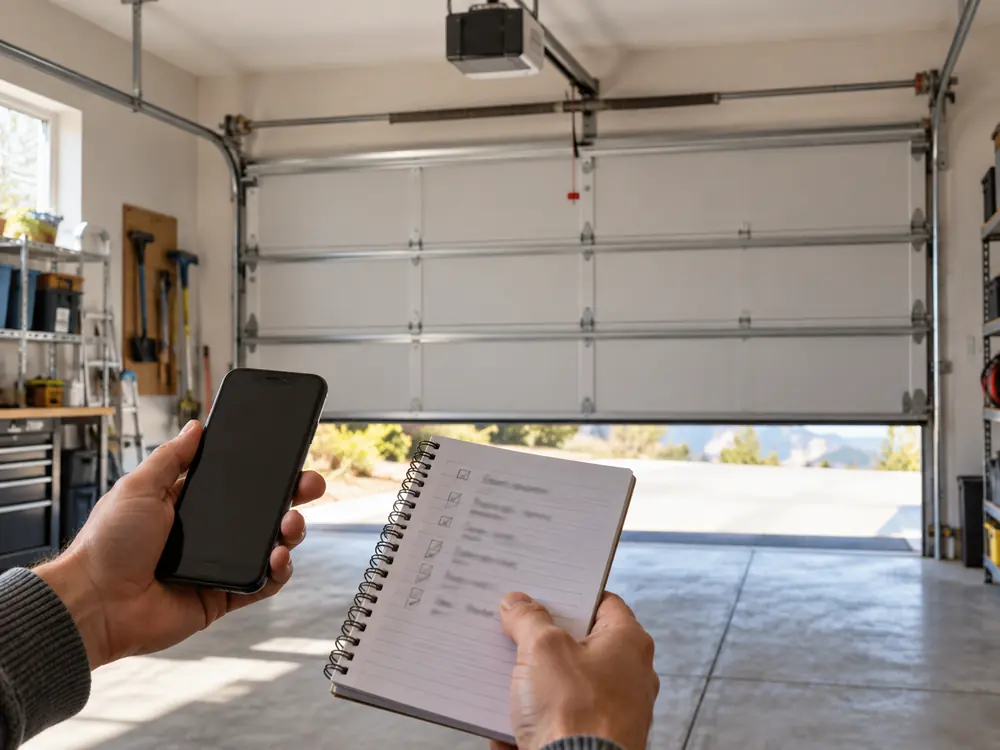
Write down when the problem started and what came first: a bang, a car bump, hail, a freeze or a power cut. Say whether the door is open, closed or partly open, and whether a car is trapped. Take one wide photo from the driveway.
What to ask on the call
One of our local garage door professionals takes it from there. Ask your technician:
- What the visit will cover for your type of door and opener.
- Whether there is a trip or diagnostic charge, and whether it is credited toward the repair.
- When a technician can come, and whether evening or weekend visits cost more.
- What the warranty covers on parts and on labor.
After the visit
Before the technician leaves, the door should stay put when stopped half-open, and it should reverse when it strikes a 2x4 laid flat on the floor. Chamberlain, maker of LiftMaster openers, says that reversal test should be repeated every month. Keep the invoice with the parts list and warranty.